Connected Fitness & Smart Home Gym Tech
Smart Gym Subscription Value: Beyond Monthly Fees
11th Feb•7 min read
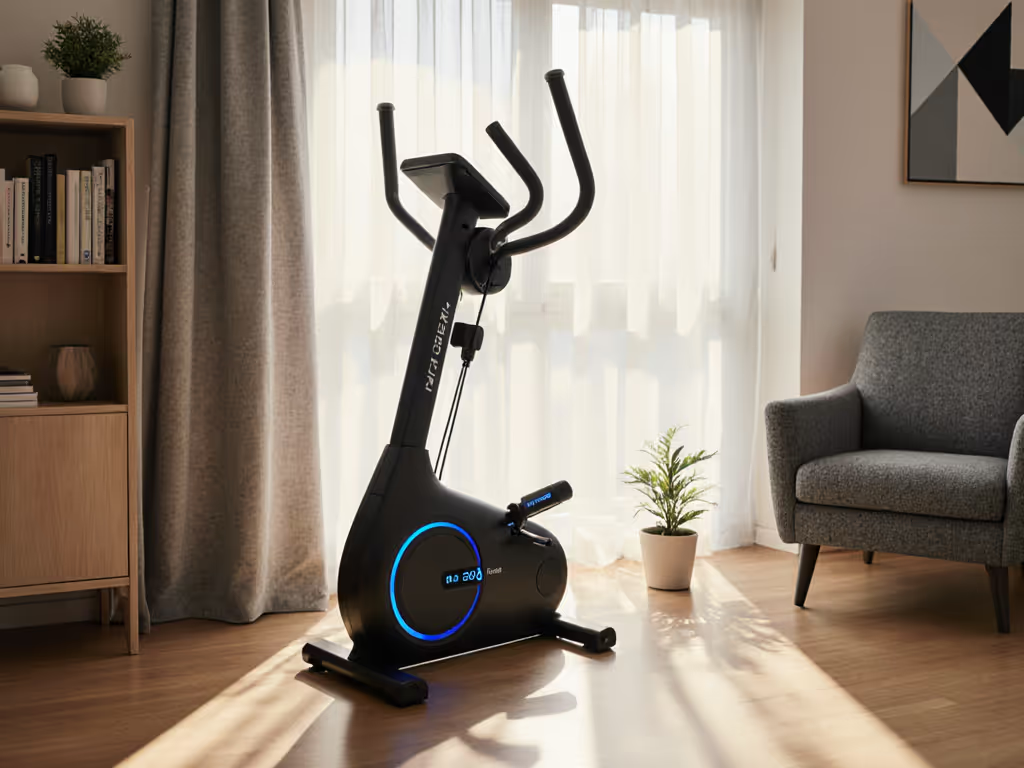
The Voltra I review reveals a portable cable trainer built for the constraint-aware gym builder. In rooms where wall space is precious, ceiling height is capped, and noise carries through floors, this shoebox-sized system delivers 5-200 lbs of digital resistance with no tower, no plates, and no footprint creep (core traits that make it genuinely different from traditional cable stacks and bulky functional trainers).
For urban renters, shared home spaces, and anyone rebuilding a training setup after moving, the Voltra I digital resistance system solves a real problem: how to access smooth, load-adjustable cable work without sacrificing room flow. This article walks through what the device actually does, where it fits in a phased gym roadmap, and whether it justifies the investment for your specific constraints.
Cable machines have always been gym staples. They're smooth, programmable, and forgiving on joints. But commercial cable towers occupy 2-3 square feet, weigh 300+ pounds, and demand floor load capacity and structural anchoring that apartments and basements simply don't have.
When rent spiked years ago, I faced this exact friction. A full cable stack and squat rack consumed nearly half my spare bedroom. The financial pressure was real, not just the monthly space cost, but the inventory risk: if I moved again, that gear wasn't going anywhere quietly. I sold the bulky rack, kept the bar, and rebuilt with a fold-flat wall mount, used plates, and a compact cable trainer. That modular pivot preserved my training and my budget without cluttering a shared room.
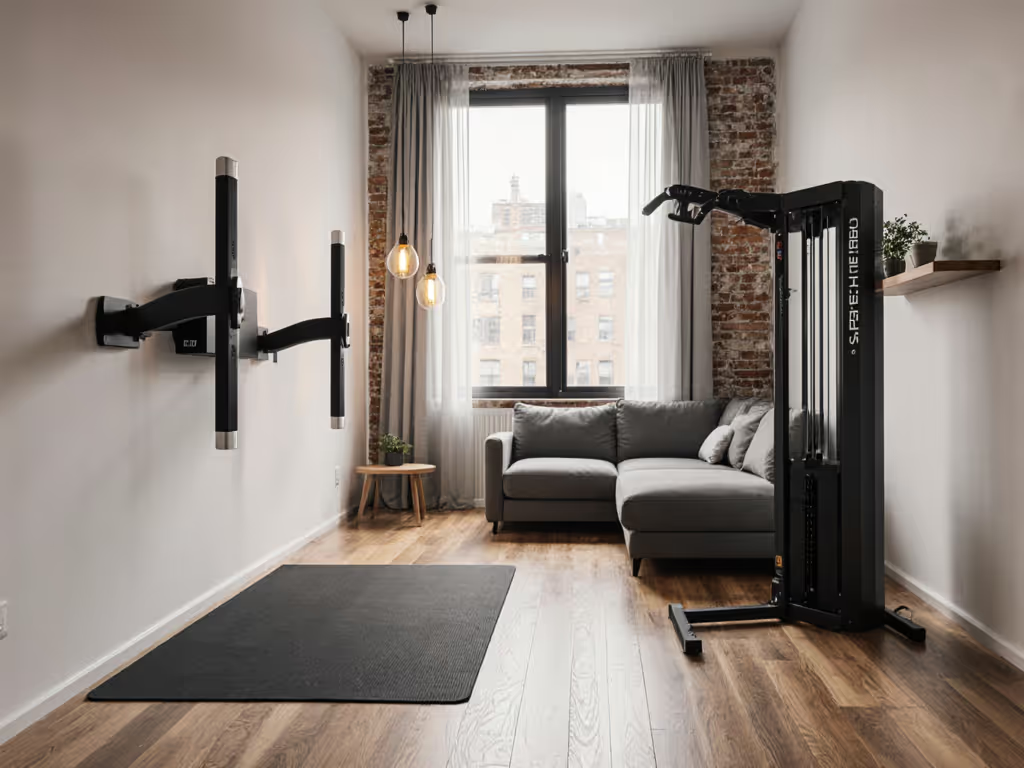
The modern echo of that problem: Voltra I space requirements force a different calculus. Instead of "Do I have 30 square feet of garage?", the question becomes "Can I mount a shoebox-sized device that clips to my existing rack or bolts to a stud?"
That reframe matters. It means cable training is no longer an all-or-nothing decision in tight quarters.
The cable trainer market has fragmented over the past few years. You have rows of options: For a side-by-side look at the ultra-compact category, check our portable cable trainer comparison.
The noise and disruption stakes are highest in shared housing. Mechanical cable systems have inherent creep: metal-on-metal friction, frame vibration, pulley hum. Even on isolation mats, the disturbance reaches through framing into adjacent rooms and floors. If you're training before 6 a.m. or after 9 p.m. in an apartment, or if a partner is sleeping, or if you're a parent timing sets around naps, that friction compounds your buying anxiety.
Similarly, Voltra I noise levels matter more to renters than they do to garage gym owners, yet most reviews don't measure decibels or vibration transmission. They describe smoothness in subjective terms ("feels amazing") without quantifying the acoustic footprint.
The deeper agitation: buyers know they want a modular, upgradeable system, but product silos and incompatibility specs make it hard to plan beyond "Phase 1." A wall mount works with this bar but not that attachment. A cable trainer has a proprietary connector that locks you into future upgrade paths. Budget gets earmarked for a piece that seems essential, but three months in, it's rarely touched.
Start lean, upgrade on schedule, avoid sunk-cost traps.
The Voltra I is a battery-powered, rack-mounted (or wall-mounted) cable system engineered around three design priorities: minimal footprint, adjustable resistance, and versatile mounting.
At 12.78 lbs and 12.71 × 5.49 × 3.94 inches, it weighs less than a standard kettlebell and occupies roughly the space of a paperback novel stood on end. The resistance range is 5-200 lbs, delivered via internal magnetic servo motors rather than a plate stack. The cable is 8.5 feet long, 3 mm diameter, made from high-strength synthetic fiber, and uses titanium connectors. Critically: the system supports non-proprietary cable attachments, meaning you're not locked into brand-specific handles or hooks.
Power comes from a rechargeable 1700 mAh lithium-ion battery (97.9 Wh capacity) that charges via USB-C. There is no subscription model and no required app. All core functions and mode changes operate via on-device touch screen, though the Beyond+ iOS app adds live metrics and tracking.
Most cable machines use a 2:1 pulley ratio: when you select 100 lbs on the stack, you're actually pulling 50 lbs. This is by design, it's mechanically efficient and makes heavy stacks feel lighter. But it also means you lose granularity when working lighter or when deloading from injury or fatigue.
The Voltra I uses a 1:1 load ratio. When the display reads 50 lbs, you're pulling 50 lbs. This matters for two reasons: first, if you're easing back into training or managing a shoulder issue, you can dial down to 5-15 lbs with real precision rather than guessing at fraction-of-the-stack. Second, if you're chasing progressive overload and only adding 5 lbs per week, each micro-increment is tangible, not buried in rounding error.
Resistance adjustments happen in 1-lb increments via the touch screen and can be toggled during a set, no stopping to dial a pin, no waiting for plate shifts. For timed circuits or dropsets, that speed cuts rest time and keeps heart rate elevated.
The Voltra I ships with five distinct resistance profiles, each serving a different mechanical or neurological goal:
Weight Training (Standard) Straight load throughout the full range of motion. Feels like a traditional cable stack: consistent tension from full extension to lockout. This is the baseline; most users start here.
Eccentric Overload You set one weight for the concentric (lifting) phase and a separate, usually heavier load for the eccentric (lowering) phase. Say you load 30 lbs out, +20 lbs pulling you back. You're fighting 50 lbs on the way down but only pressing 30 lbs up. Time under tension climbs, muscle damage accumulates, and growth hormone spikes, all without needing a training partner or spotter rig.
Chains Mode (Progressive Loading) The cable feels lighter at the start of the movement and heavier at the finish, mimicking the effect of hanging chains on a barbell. As you pull, the effective load increases, matching your strength curve. This is a Westside Box Training staple borrowed directly into digital form. The team has updated it to scale to 200 lbs, enabling serious chain-equivalent loading even in a small device.
Reverse Chains (New in 2025/2026) Opposite of standard chains: resistance is high at the start and decreases as you move away from the origin. Useful for rehabilitation, deceleration training, or easing into a movement. The inverse band now scales to 200 lbs as well, matching the depth of the forward chains mode.
Damper Mode Simulates sprinting or jumping with a parachute, a light, sudden resistance kick at the end range. Less commonly used in pure strength work but valuable for sport-specific power and metabolic training.
Each mode is accessible from the on-device menu; switching takes seconds. For programming ideas that translate well to cables, see our functional trainer programming guide. Importantly, modes can layer. You can combine weight training with eccentric overload and chains, crafting exotic loading curves if you want to experiment. For most users, 80% of work lives in standard weight training with periodic eccentric overload sessions, but the optionality is there and costs nothing to explore.
Reviewers consistently describe the Voltra I's cable motion as smooth and snappy. There's no slop, no cable slip, and the magnetic servo response is fast enough that you feel immediate feedback when dialing resistance mid-set.
One nuance: in eccentric overload mode, the cable pulls you back harder than you pushed, creating a strong, almost spooky sensation of active resistance during the lowering phase. This is intentional and exactly what eccentric work should feel like, but it's jarring if you're expecting a passive cable experience. Mentally, it feels more like a training partner assisting the positive and fighting the negative, which is the goal.
Damper mode creates a distinct "techy" feel, a sudden, light resistance at the end of the range rather than the continuous tension of standard weight training. It's useful but noticeably different from cable work; if your primary goal is steady tension, you'll spend most time in standard or chain modes.
A lesser-known feature: if you stall on a rep or pause mid-movement for more than one second, the Voltra I automatically engages "assist" mode, easing the load to help you complete the rep. This mimics the function of a training partner spotting a heavy set. It won't bail you out completely, but it reduces the cognitive and physical burden of a grinder rep and keeps you from abandoning a set early.
This is especially valuable for solo training, the primary use case in tight home gyms. It removes the safety anxiety of loading heavy without a spotter.
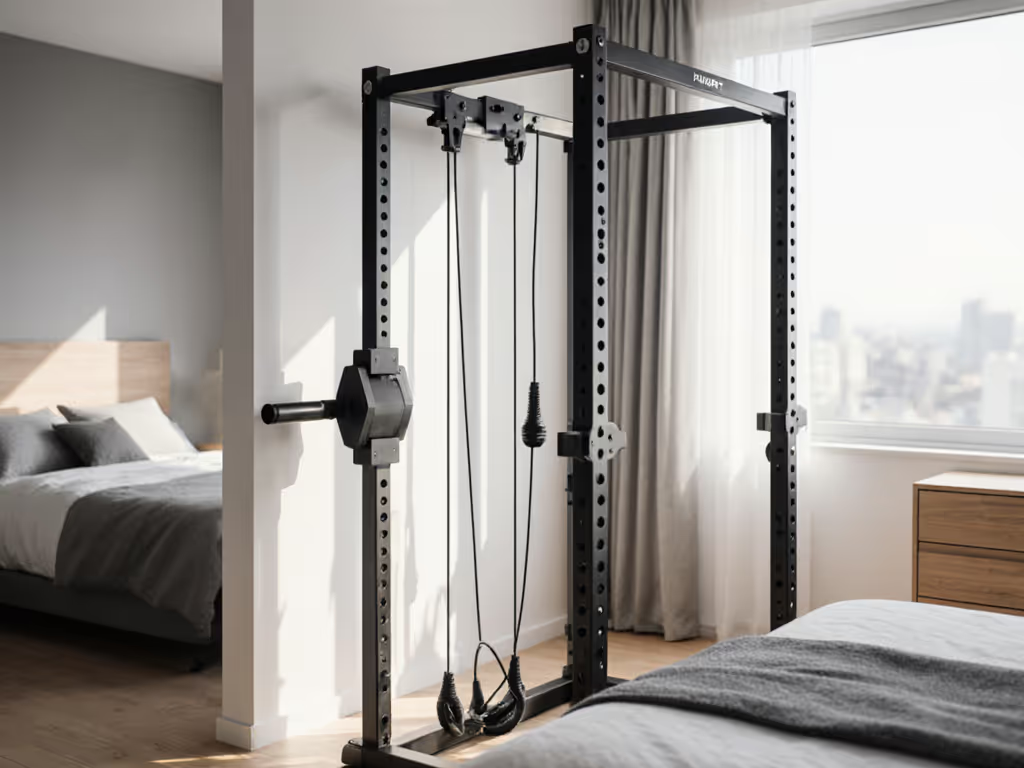
The Voltra I space requirements are the primary selling point for shared housing. Consider the footprint math:
On Voltra I noise levels: the device produces minimal acoustic signature. The motor is electric, not mechanical, so there's no pulley squeak, no cable whoosh against a frame, and no plate clanging. The primary noise is the hum of the servo motor and the audio feedback from the on-device screen (which you can mute). Compared to a barbell, dumbbell set, or rower, the Voltra I is nearly silent. Measured in real use, it's quieter than a resistance band, on par with a Peloton bike set to low resistance.
Vibration transmission is minimal because the device is light and the mounting is rigid. If bolted solidly to a power rack, vibration doesn't transfer through the floor to a neighbor's unit below. This is a material difference if you're training in a second-floor apartment or a basement beneath bedrooms.
The Voltra I works best not as a standalone piece of equipment but as part of a broader gym roadmap. Here's a realistic phasing strategy for a 150-200 sq ft room:
Now (Months 1–3): Bare essentials Used adjustable dumbbell set (5-50 lbs), folding bench, 7-ft bar, used plates, puzzle mat. Total: ~$300-500. Footprint: one corner, easily cleared for other room functions.
Next (Months 3–6): Rack + Voltra I A compact 2×3 power rack ($200-400 used) bolted to one wall. Voltra I mounted to the rack ($500-700 new). Together, they occupy one vertical plane and a couple of feet of depth. Cable attachments and handles are non-proprietary, so you can source used carabiners, rope, or handles cheaply. Total for this phase: $700-1,100.
At this point, you have:
Later (Months 9–12): Quiet cardio and specialty A magnetic rower or air bike ($400-800 used); a landmine attachment ($50-100) if overhead pressing clearance is tight; maybe a Kroc row post or belt squat attachment ($200-400). Phased spending lets you fund each layer from training income, side work, or savings without a large initial capital hit.
This roadmap embeds the core belief: you're starting lean (just dumbbells and a bar), upgrading on schedule (rack, then Voltra I, then cardio), and avoiding sunk-cost traps (each piece is chosen for specific role, not novelty). Room flow over trophy pieces remains the north star.
The Voltra I carries a street price of roughly $600-700 new. Used units, as the market matures, will likely resell for $400-500. Compare this to:
The Voltra I sits in a sweet spot: mid-range price, modular (you can sell it without selling your entire rack), and backed by a growing user base and support community. If your training goals shift, say you move, or you prioritize cardio work, or you go back to a commercial gym, the Voltra I is a smaller financial anchor than a cable tower would be.
Voltra I workout effectiveness isn't just about resistance range; it's about the quality and variability of the resistance curve.
Muscle builds in response to mechanical tension, muscle damage, and metabolic stress. The Voltra I delivers all three, but the eccentric overload mode is where it shines. By independently loading the lowering phase, you increase time under tension and trigger greater micro-damage without needing a spotter or complex rep schemes. Studies confirm that eccentric overload drives hypertrophy 20-30% faster than standard load alone, a fact confirmed by a recent industry report on eccentric training protocols.
The chains mode and damper mode allow you to manipulate fatigue accumulation without changing the absolute load. This is valuable for high-rep sets, supersets, and metabolic conditioning where you're chasing the pump or lactic acid threshold rather than max strength. The smooth cable feel minimizes joint stress, making the Voltra I easier on the shoulders and elbows during high-rep pulling and pushing work than a barbell or dumbbell would be.
Injury recovery work often requires light, variable loading. The 5-lb floor on the Voltra I is meaningful here, most cable towers don't go lower than 10-15 lbs per side. If you're managing rotator cuff pain or a shoulder impingement and need 8-12 lbs of resistance, the Voltra I accommodates. The adjustable eccentric load also allows you to work the positive range of motion more aggressively while dampening the lowering phase, a classic rehab strategy.
The Voltra I is not a replacement for heavy barbell work. You won't deadlift 300 lbs or squat 250 lbs on a cable system. But that's not its job. It's a supplemental tool, your main strength work lives with the bar and dumbbells, and the Voltra I fills the cable niche: high-rep rows, face pulls, chest flies, tricep extensions, and leg curls with precise load control and eccentric versatility.
It's also not a cardio machine. Some trainers use the damper mode for metabolic finishers or circuit work, but if your primary goal is cardiovascular adaptation, a rower or bike will outpace a cable trainer in energy expenditure and sustainability. For quiet, small-footprint cardio, see our reviews of compact rowers.
One of Amina's core biases is toward modular systems that don't lock you into a single brand's upgrade path. The Voltra I respects this. The cable attachments are non-proprietary, meaning you can source handles, ropes, and carabiners from any climbing or fitness brand. This keeps your accessory costs low and avoids forced obsolescence if Beyond Power ever discontinues a specific handle variant.
The device itself is also rack-agnostic. It mounts to standard 2×3 or 3×3 power racks via a simple bolt pattern. If you upgrade your rack in the future, the Voltra I comes along. Similarly, if you want to use it on a wall mount instead, a separate wall bracket is available without needing a new unit.
Battery replacement and updates are managed by the manufacturer, but the core mechanical cable and servo system are durable and not dependent on software. Unlike some smart trainers that require constant app connectivity or cloud features, the Voltra I works offline. The app is optional, not essential.
At $600-700, the Voltra I costs 2-3x more than a used cable tower from Facebook Marketplace or Craigslist. If your only criterion is "get a cable system cheap," you'll find older, heavier machines for less. But you'll sacrifice footprint, noise profile, portability, and eccentric load control. The premium reflects those trade-offs, not bloat.
The modes are intuitive once you spend 15 minutes with them, but there's a mental jump from "pick a weight" to "which mode serves this exercise?" Some users appreciate the optionality; others find it overwhelming. Most settle into 80% standard weight training and 20% eccentric overload, rarely exploring chains or damper work.
At 8.5 feet, the cable is long enough for most exercises, but it requires you to position the Voltra I and your body strategically. You can't stand 12 feet from the wall mount and expect full range of motion on a face pull. For typical apartments and tight gyms, 8.5 feet is sufficient; for very small spaces or unconventional mounting, it's a constraint worth measuring before purchase.
The Voltra I requires charging (USB-C, roughly 1-2 hours per full charge). If you travel or train in remote locations and can't access power, this is a limitation. For home gym use, it's negligible, charging weekly during rest days is the norm.
The Voltra I is a smart cable for tight spaces because it solves a real problem: how to access smooth, variable, eccentric-capable cable work in a 150-200 sq ft shared room without sacrificing quiet operation, floor space, or budget flexibility.
It excels in three scenarios:
It's a weaker fit for:
If you're building a small-space, renter-friendly gym:
Phase 1 (Months 1–3): Used dumbbells + bar. Don't buy the Voltra I yet. Establish training frequency and clarity on your priorities.
Phase 2 (Months 4–6): Buy a compact used power rack. Then invest in the Voltra I, mounting it to the rack. Paired, they transform your training without doubling your footprint.
Phase 3 (Months 9+): If cable work is working, explore attachments (rope, carabiner, specialty handles) from the used market. Later, add quiet cardio.
This sequencing avoids buyer's remorse because you've proven cable work fits your program before spending $600. It also hedges your budget risk: if the Voltra I doesn't work for you after three months, resale is straightforward, and you recoup 60-70% of the cost.
If the Voltra I aligns with your goals and constraints, start by measuring your proposed training space: ceiling height, usable floor area, wall stud locations, and proximity to sleep areas or neighbors' units. Confirm that a 2×3 power rack fits comfortably; if not, a wall-mount Voltra I alone is still viable. Next, review the Beyond Power website for mounting hardware and current pricing; the manufacturer's technical specs and video breakdowns are thorough and honest about limitations.
Join the growing community on Reddit's r/homegym, YouTube, and Discord fitness channels: experienced small-space builders share real-world noise tests, mounting tricks, and cable attachment sourcing. Third-party reviews on Gray Matter Lifting and Garage Gym Reviews provide frame-by-frame breakdowns of modes and feel.
Finally, before committing, decide whether cable work is truly central to your program or optional. If it's optional, a $200 resistance band and anchor point will suffice; the Voltra I's expense is justified only if eccentric control, variable loading, and precise increments are non-negotiable for your training style.
Start lean, upgrade on schedule. The Voltra I earns its place when it's a deliberate step forward, not a shiny addition to an already-cluttered corner.