Training & Programming with Limited Equipment
Apartment Hypertrophy Blueprint: Equipment & Program
8th Apr•8 min read
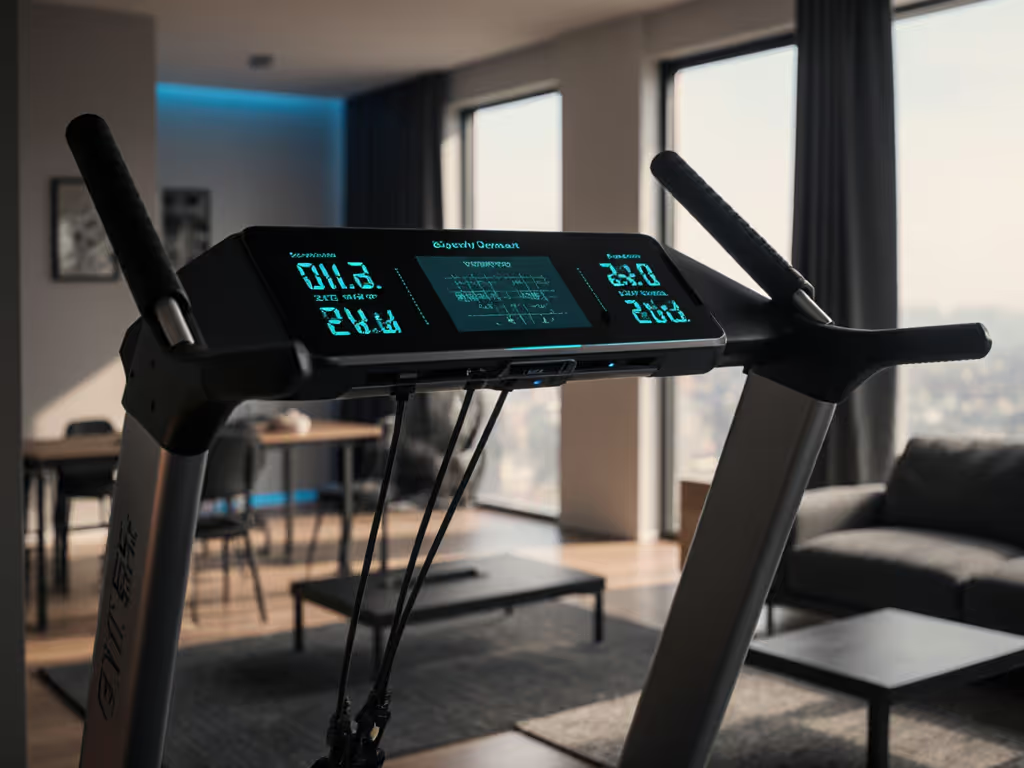
Choosing equipment without a programming framework is like furnishing a room without a floor plan, you end up with scattered pieces that look expensive but feel cramped. A Speediance programming guide and digital resistance training approach flips this order: decide what your workouts demand, then select gear that fits both your space and your progression timeline.
Most people start with aesthetics or brand loyalty instead of asking the harder question: What does my training actually require, and how does it change over six, twelve, and twenty-four months? That gap between "what I own" and "what I need to progress" creates two traps. First, you buy a cable tower because it looks complete, but then discover it eats 40% of your room and forces you to compromise door swing and storage. Second, you outfit for today's goals and find yourself locked into that setup when priorities shift (a new job, kids, a move, or a shift from hypertrophy to mobility-first training).
The agitation is real: without a phased programming plan, each purchase feels isolating. You can't see how a new attachment serves your training structure, so justifying it (and storing it) becomes harder. Add space constraints, noise sensitivity, and a tight budget, and paralysis sets in. Room flow over trophy pieces, but how do you know which pieces actually flow?
Digital resistance systems solve this by decoupling equipment from intuition and anchoring it to your actual training logic. Unlike free weights or machines, which force you to work within their fixed resistance curves, systems with adjustable digital resistance (including options like the Speediance Gym Monster) let you align your equipment directly to programming principles: progressive overload, movement variety, and time efficiency.
Here's why that matters for a space-constrained, budget-aware athlete:
Precise progression without waste. Digital resistance adjusts in 1-pound increments (often up to 220 lbs) and automates load increases as you adapt. You don't buy 5- and 10-pound plates you'll outgrow or underuse. One machine replaces a sprawl of dumbbells, kettlebells, and machines that once lived in corners.
Movement variety on one footprint. A quality digital resistance system supports 700+ exercise variations - pulling, pressing, rotating, loaded carries, unilateral work - with cables that slide between low, mid, and high positions. That versatility means you can program full-body routines without swapping stations or blocks of equipment.
Real-time form feedback and data. Tracking reps, sets, and weight lifted isn't vanity. It creates accountability, reveals plateaus early, and proves progress when motivation dips on a cold Tuesday at 6 a.m. Apps that sync to your workouts become a training memory you can reference during future phases.
Modular resistance modes. Systems offering standard, chain, eccentric, and constant-speed modes let you shift your programming stimulus without adding hardware. Training for strength? Standard mode, heavy, low reps. Recovering from injury? Constant-speed mode keeps tempo locked and predictable. Building posterior chain resilience? Eccentric mode loads the lowering phase.
Phase: Now (Months 1-3: Foundation, $150-600)
Start with cables and core patterns. Rows, presses, pulls, carries, and rotations. Focus on mastering movement, not load. This phase answers the first critical question: Do I actually use this system? If you discover you dislike cable training or can't sustain 3-4 sessions per week, you've avoided a $3,000 mistake.
Compatibility note: Choose a digital system with solid app integration and beginner-friendly programs. You're learning to trust the tool. If you're choosing between leading systems, see our Tonal vs Speediance comparison for noise, space, and long-term value details.
Space reclaim: A compact cable system occupies 4 square feet or less (ideal for a corner, spare bedroom, or basement nook).
Phase: Next (Months 4-8: Progressive Complexity, +$200-500)
Add targeted attachments that serve your emerging priorities. If you lean toward lower-body emphasis, add ankle straps for cable kickbacks, lateral walks, and leg curls. If upper-body pressing is your north star, add a handle that supports overhead movement at multiple heights.
Resistance progression logic: By now, you're hitting the upper end of standard mode on foundational moves (typically 160-200 lbs). Eccentric mode (higher resistance on the lowering phase) extends challenge without requiring heavier weight, protecting your joints while building strength and deceleration control.
Compatibility note: Confirm that new attachments lock securely and that cable paths don't tangle. Document dimensions and weight limits in a simple spreadsheet.
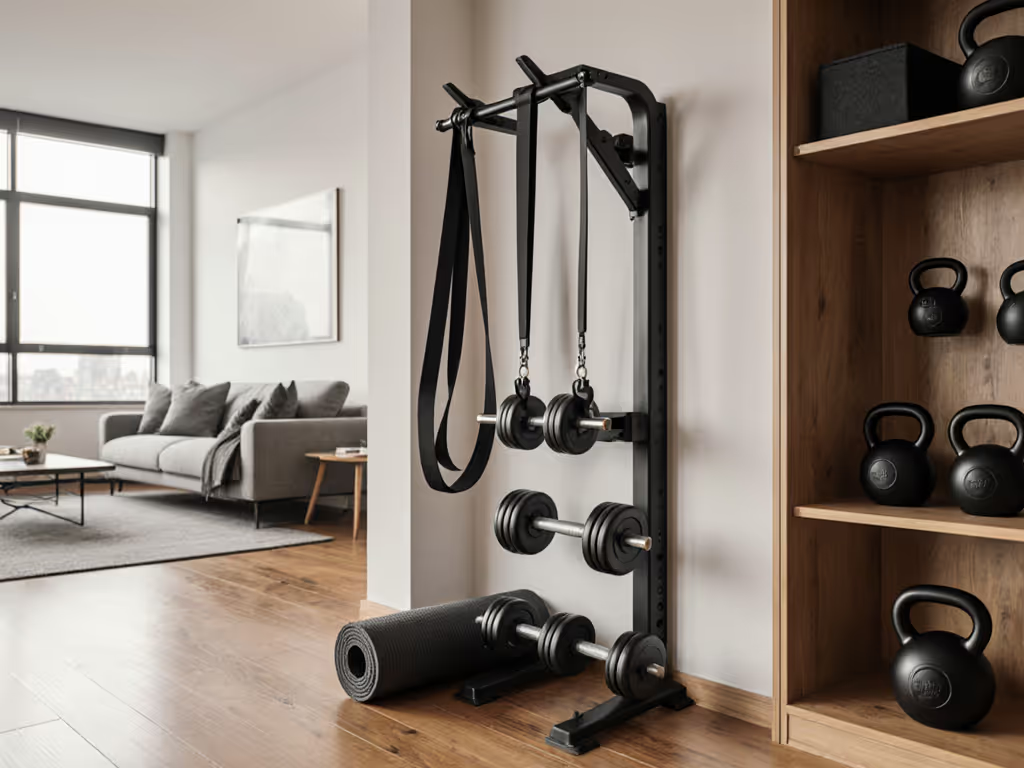
Space reclaim: A fold-flat attachment rack or wall-mounted bracket keeps cables tidy and clears floor space for mobility work or equipment rotation.
Phase: Later (Months 9-24: Specialty and Contingency, +$300-1000)
This is where you add conditional or goal-specific tools. If bench pressing matters, invest in a cable-compatible bench. If your knees ask for unloaded lower-body options, consider a belt squat or sled. If noise is creeping into your life (a new partner, remote work in a neighboring room), swap cable dropsets for slow eccentrics or constant-speed mode to reduce impact clang. For apartment-friendly setups, use our apartment gym noise control guide to pair quiet training modes with sound-dampening fixes.
Resistance progression logic: Chain mode becomes your friend. As you pull the cable handle up (toward full range), resistance increases, mimicking the strength curve of heavy barbell lifts. It's strength-building without the neurological tax of maximal singles.
Compatibility note: Before buying, simulate the piece in your space using a tape outline. This trick (learned when I sold my bulky rack, kept the bar, and rebuilt with a fold-flat wall mount) saved me from another false start.
Space reclaim: Choose accessories that nest, stack, or hang. Bench legs that fold, handles that clip to a ring, straps that coil into a pouch.
Digital resistance systems shine when you pair them with structured programming. For cable-specific routines and progressions, follow our functional trainer programming guide to structure effective blocks. Track which exercises, which resistance modes, and which rep ranges delivered your best results. If you notice that eccentric-mode cable rows boosted your pull-ups faster than standard mode, you've found a leverage point. Next phase, you double down on eccentric-focused blocks.
You're not guessing anymore. You're iterating on data.
Compatibility note: Ensure your system exports workout history (CSV, PDF, or app archive). This prevents lock-in if you ever switch platforms or want to share programming with a coach.
The deepest insight: a programmable, space-efficient system isn't just about strength. It's about room identity. Your workout corner shouldn't feel like a commercial gym squeezed into a bedroom. It should feel intentional, tidy, and aligned with the rest of your life, a place where a video call doesn't scream "I hoard fitness gear."
Choose equipment that stores compactly (cables fold, benches nest, handles clip), finishes that complement your decor (matte black or walnut over neon chrome), and footprints that don't colonize your floor plan. That discipline extends your training consistency because the room doesn't nag at you on rest days.
Your next move isn't to buy more. It's to clarify: What is your training goal for the next 12 weeks? Strength? Hypertrophy? Mobility recovery? Conditioning? Once that's clear, audit the three phases above and identify which system and attachments actually serve that mission. Ignore the rest.
Then, reach out to community (Reddit's r/HomeGym, fitness Discord servers, YouTube reviewers who test noise and footprint, not just marketing hype). Ask specific questions: How does eccentric mode feel on cable rows? Does the machine settle on a thin apartment floor? Collect data. Build confidence.
The best gear is the one you use, not the one you own. Start lean, build progressively, and let room flow guide your choices.