Connected Fitness & Smart Home Gym Tech
Voltra I Review: Smart Cable for Tight Spaces
27th Mar•19 min read
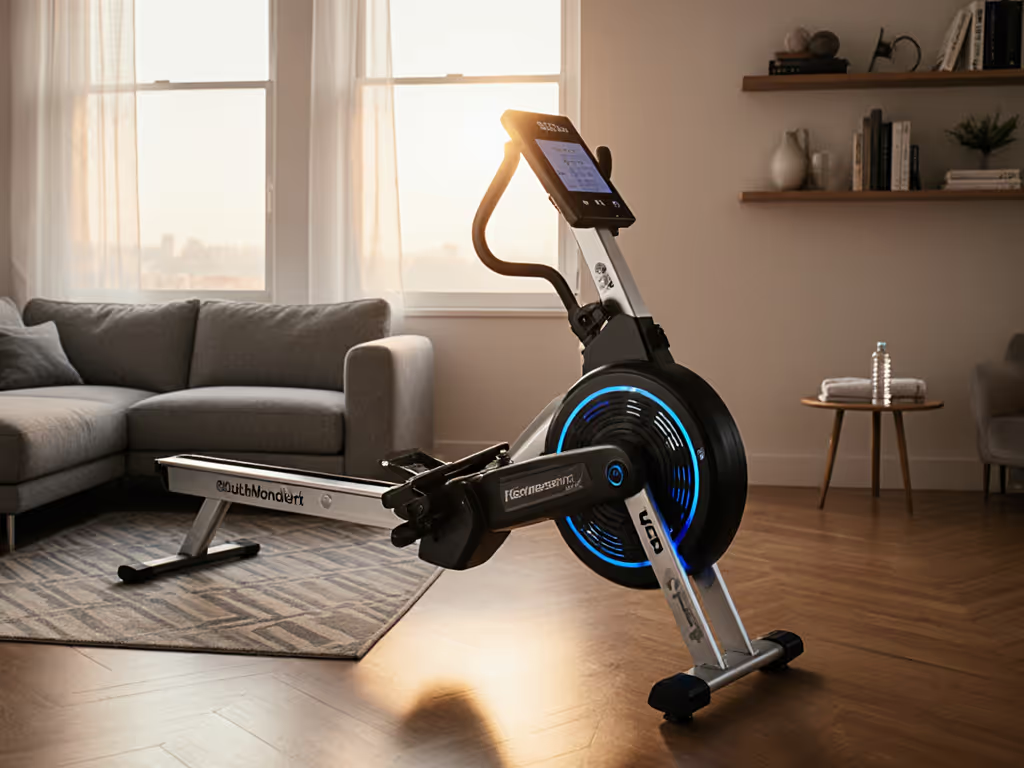
When you're fitting exercise rowing machines into an apartment or condo, you're navigating two competing realities: the need for a genuinely capable machine and the requirement that it doesn't alienate your neighbors or disrupt your household. A smart rower comparison isn't really about features alone, it's about which machine lets your room stay calm and inviting enough that you'll actually use it regularly. Flow first: the room should invite training, not clutter.
The residential rower market has split sharply. On one end sit cinematic, subscription-dependent machines built for competitive gamification. On the other sit quiet, compact magnetic rowers that prioritize acoustics and footprint over flashy screens. Your choice depends less on bells and whistles and more on how the machine fits into your life.
Magnetic resistance rowers are the apartment athlete's default choice. A well-designed magnetic model operates at under 25 decibels during steady-state work (roughly the noise of a whispered conversation).[1] This matters because you're not just thinking about your morning session; you're thinking about 6 a.m. rows while a partner sleeps, or evening intervals before kids' bedtime.
For comparison, air and water rowers generate more mechanical noise. For a deeper breakdown of acoustic differences and home fit, see our water vs air rower comparison. Air rowers produce a continuous fan whir that compounds with each stroke, and water rowers create rhythmic splashing that travels through floors and walls. Magnetic rowers, by contrast, use silent electromagnetic braking, making them the go-to for noise-sensitive environments.[3]
If silence is non-negotiable, space, silence, and savings converge in models like the YPOO magnetic rower, which combines near-silent operation with a compact 2.9 square-foot footprint and vertical foldability.[1] That combination (sub-25dB acoustic profile plus the ability to store the machine away) removes the visual and auditory clutter that undermines adherence over months.
This is where marketing claims collide with reality. Most rowers quote their rowing length (typically 94-96 inches) but don't mention the reach envelope, the space you need around the machine to set up, move the seat freely, and exit safely.
A compact model like the YPOO occupies a stated footprint of 2.9 square feet when folded and stored vertically, but during use it extends along a 46-inch dual rail.[1] You'll want at least 110 inches of clear length in front and 36 inches of clear width to each side for entry and adjustments. In a studio apartment or spare bedroom, that footprint claims the majority of usable floor. Plan pathways and stash gear with our home gym storage solutions.
More advanced models, like the Hydrow Wave, are engineered with a foldable neck and screen mechanism, collapsing the profile despite a larger overall frame.[5] This design choice reflects a real shift toward small-space usability. The machine stays in the room but can be positioned or folded to free walking paths.
If it looks calm, it trains calm, and that means a machine that doesn't visually monopolize or block your exits.
This is where the "smart rower" market fragments your budget. Some machines bundle free app ecosystems; others lock you into monthly fees.[3] To project true cost of ownership, use our smart gym subscription value guide.
The NordicTrack RW900, for example, requires a membership for full capability at $50/month, roughly $600 yearly.[3] If you train consistently over three years, that's $1,800 in recurring costs on top of hardware.
Conversely, budget-friendly magnetic models like the YPOO integrate with free apps like SunnyFit and Kinomap, offering guided workouts and virtual training sessions without recurring fees.[1] Similarly, some manufacturers bundle lifetime app access, a massive value differentiator when comparing machines in the $600-$1,200 range.
When evaluating smart rower subscription costs, factor the cost-per-use over your likely ownership window. A $1,500 machine with free app access has a lower true cost than a $1,200 machine that demands $50/month indefinitely.
Magnetic resistance tiers matter more than you'd think. A 16-level magnetic system (typical in budget to mid-tier models) offers enough granularity for progression from beginner to intermediate training, but lacks the finesse for advanced athletes who prefer single-level increments.
The YPOO rower uses a 16-level magnetic resistance system with a 99-pound magnetic damper, supporting users up to 350 pounds.[1] Stepping between levels remains silent; the electromagnetic braking adjusts without mechanical clunk or vibration transmission.
More sophisticated models, like commercial-grade machines used in rowing clubs, employ heavier flywheels and multiple resistance pathways, but they also risk creating feedback into floor joists if mounted improperly. For apartments, a well-tuned magnetic rower with 16-32 resistance levels and a stable, independent frame is the sweet spot between progression and acoustic silence.
Rowers are relatively vertical-footprint-friendly compared to racks or pull-up bars, but they're not ceiling-agnostic. Most rowers sit 48-52 inches tall when upright, and if your machine has a screen that tilts or a frame that extends skyward, you need to account for that clearance.
In my experience designing setups for tight spaces, including one client's attic gym with sloped ceilings and a single dormer window, I've found that rotating or reorienting the machine, then swapping bulky components for low-profile alternatives, opens up reach envelopes and clearances that initially seemed impossible. Wall-mounted storage, neutral color palettes, and machines with fold-forward screens preserve the visual calm that keeps people training.[1]
Before ordering, measure your ceiling height at the point where the rower will sit, account for at least 6 inches of clearance above the machine frame, and verify that the screen doesn't pitch upward during use.
If your priority is silence, footprint, and zero monthly fees, the YPOO magnetic foldable rower checks every box.[1] At 16 resistance levels, a 350-pound capacity, and sub-25dB operation, it's engineered for apartments. Its 6.5% incline design adds metabolic intensity without increasing noise, the stroke simply simulates uphill rowing, burning more calories per rep without mechanical complication.
The foldable rail compresses vertically for storage, making it ideal for shared spaces where visual clutter signals underuse. The trade-off: no built-in screen or app integration beyond third-party compatibility.
If you want app integration, guided coaching, and competitive elements without sacrificing quiet operation, magnetic models with touchscreens (like certain mid-tier Hydrow or NordicTrack variants) bridge the gap. However, verify the machine's decibel rating independently; touchscreen models often add weight and structural complexity that can introduce subtle vibrations.[2] For model-by-model noise and size notes, check our compact rowers review.
The Hydrow Wave stands apart as the most advanced smart rower available, combining guided workouts, real-time coaching, and compelling on-screen competition, but at a premium price and with a membership requirement.[5] It's ideal for users who thrive on visual feedback and gamified training, not pure data tracking. Hydrow also publishes realistic noise data and space requirements, helping you avoid surprises.
However, if your apartment has neighbors below or a partner with a light sleep, the premium price doesn't automatically buy you silence. Measure twice, integrate flooring isolation, and don't assume a brand name guarantees quiet.
Here's the insight that separates a rower that gathers dust from one that builds a training habit: storage density metrics and visual simplicity matter as much as the machine itself.
A foldable rower that stores vertically against a wall or in a closet removes the visual anchor that signals "fitness space." Conversely, a permanently horizontal machine anchors a room's identity, making it harder to use the space for other purposes (work, family gathering, meditation). If your apartment combines living and training zones, a compact, foldable magnetic rower with neutral color palette becomes a piece of gear that belongs to your life, not a monument to a fitness phase.
Mounting the rower's footrest or frame to a rubber isolation mat also reduces vibration transmission through joists and into neighboring units, a detail often overlooked but critical for maintaining apartment harmony. Get step-by-step tips in our apartment gym noise control guide.
Smart rower comparison ultimately hinges on three variables: acoustic profile (decibels), physical footprint (stored and in-use dimensions), and cost structure (hardware plus subscriptions). For apartment dwellers, magnetic rowers outperform air and water models because they operate at whisper-level noise and integrate easily with foldable storage.
Choose based on whether you prioritize:
Measure your actual space, listen to decibel ratings (don't assume), and choose a machine that invites you to train, not one that feels like an obligation. If it looks calm, it trains calm.
To narrow your choice, pull the exact dimensions and decibel ratings for your top three contenders, create a quick floor plan overlay showing the rower's in-use and stored positions, and test the app ecosystem (most offer free trials) before committing. Check independent reviewer measurements, especially YouTube creators who use sound meters and footprint calipers, not just qualitative impressions. Finally, contact the manufacturer's support team with your ceiling height, floor type, and noise concerns; honest brands will tell you if their machine is a fit or a misfit for your situation.