
Compact Air Fryer Comparison: Tested for Noise & Footprint
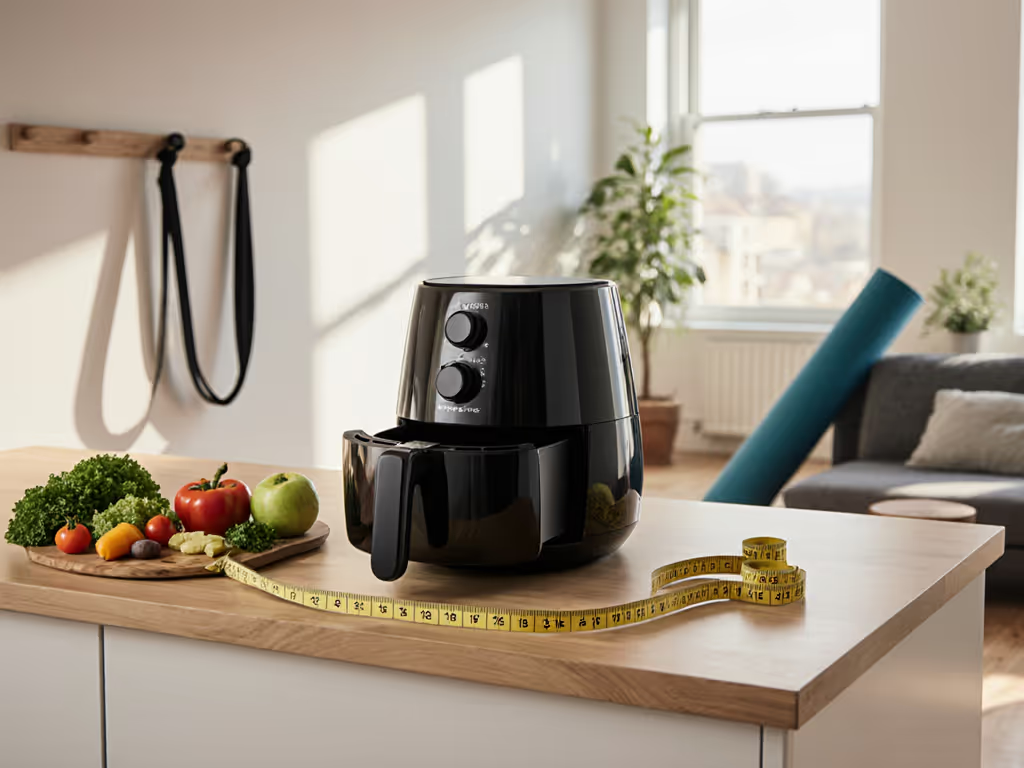
Why Compact Air Fryers Matter for Small-Space Living
If you're training at home, meal prep isn't optional (it's foundational). But when your kitchen footprint is measured in feet, not yards, or when you share walls with neighbors sensitive to mid-morning or late-night activity, every appliance choice compounds the constraints. Compact air fryer comparison starts with a room audit, not a brand hunt. You need to know whether your counter space, electrical setup, and acoustic environment can accommodate the gear without friction.
Post-workout meal prep appliances have exploded in the home gym space. But most reviews ignore the metric that matters most to apartment dwellers: noise and vibration transmission. This guide cuts through that gap. We'll map the footprint realities, test decibel profiles at 1m and 3m, and show you how to position quiet air fryers for seamless post-lift nutrition without waking your household or disturbing neighbors. To manage heat and cooking odors in tight spaces, see our home gym ventilation guide. The principle is straightforward: measure first, then let the room choose the gear.
FAQ: Compact Air Fryer Selection for Small Spaces
What Are the Real Footprint Differences Between Compact Models?
Compact air fryers cluster around three capacity bands, and each has distinct floor implications.
2-Quart Models (smallest class):
- Typical footprint: 8-9 inches (20-23 cm) width × 10-12 inches (25-30 cm) depth
- Counter footprint: ~0.5 sq ft (0.05 m²)
- Clearance needed above: 6-8 inches (15-20 cm) if venting rearward
- Weight: 2.5-3.5 lbs (1.1-1.6 kg)
- Best for: Studio apartments, dorm rooms, tiny kitchens, or as a secondary fryer in a multi-zone home gym kitchen
3-Quart Models (midrange):
- Typical footprint: 9-10 inches (23-25 cm) width × 11-13 inches (28-33 cm) depth
- Counter footprint: ~0.65 sq ft (0.06 m²)
- Clearance above: 7-10 inches (18-25 cm)
- Weight: 4-5 lbs (1.8-2.3 kg)
- Best for: Most apartments, townhomes, and small kitchens; capacity sweet spot for 1-2 person households
2.6-Quart Models (tweener):
- Typical footprint: 8.5-9.5 inches (21-24 cm) width × 12-14 inches (30-36 cm) depth
- Counter footprint: ~0.65 sq ft (0.06 m²)
- Weight: 3.5-4.5 lbs (1.6-2 kg)
The difference between 2 quart and 3 quart is roughly 1 inch (2.5 cm) deeper (meaningful if your kitchen counter is already tight). Measure your usable counter space first. I learned this lesson early: in my first apartment with paper-thin walls, I was so focused on heating speed that I overlooked how corner placement actually amplified vibration against the shared wall. Once I mapped the room, layered isolation underneath, and tested placement with a decibel meter, everything changed. For vibration-damping mat options that reduce counter buzz, compare our soundproof gym flooring tests. The neighbor later said it was noticeably quieter.